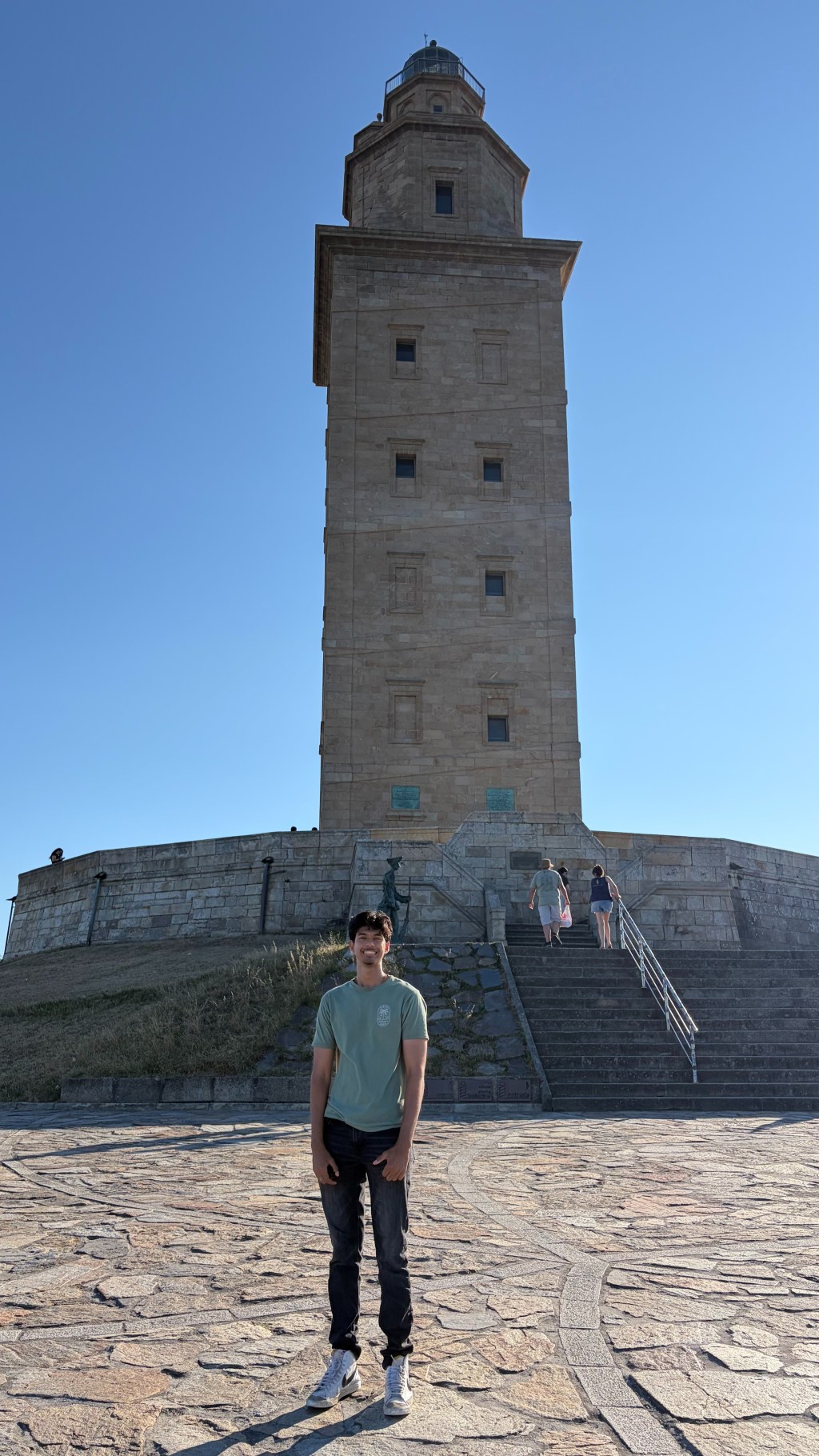
My first week in A Coruña, I sat at a desk in a municipal office, across from a clerk who spoke only Spanish and Galician, trying to get a bus card. I had the little Spanish I’d been studying before landing, and he had the patience of someone who does this every day. He’d ask me something, I’d answer a question I wasn’t entirely sure I’d been asked, and we went back and forth like that for the better part of twenty minutes – a kind of negotiation by trial and error, both of us guessing at what the other meant and adjusting when the guess was wrong. By the end of it, some mix of gesture, guesswork, and his patience got me there, and I walked out with a bus card in hand. Coming off a semester abroad in London, I thought I’d gotten good at cultural differences – good enough that I wanted to stay in Europe for the summer. I chose Spain for two things: to practice my Spanish, and to work on a cutting-edge project applying machine learning to cybersecurity. What I didn’t expect was that the first would turn out to be the exact shape of the second.

Because this summer, I’ve been sitting in a lab at the Centro de Investigación en Tecnologías de la Información y las Comunicaciones (CITIC) trying to teach a language model to do something similar: make sense of a language it had never been trained to speak. My project asks whether a large language model can look at raw network traffic – the packets of data flying between your laptop and the internet, thousands of times a second – and correctly guess what operating system sent them. It’s a question people have answered before, but I wanted to know if a machine learning model could learn to read the same signals a human expert would.
The problem is that a network doesn’t produce sentences, or even words. It produces packet captures, or PCAPs – the accumulated raw data of machines talking past each other. Before I could ask a model anything, I had to translate these PCAPs into something readable, and it turned out there was no single right way to do it. I spent the better part of a month testing a growing list of Tshark commands (a tool for converting PCAPs into text) trying to find the balance between extracting the complete raw data – more accurate, but too much for the model to usefully read – and filtering it down to something it could actually work with. It reminded me, more than I expected, of that desk in the municipal office: too little context and you’re lost, too much and you’re still lost, just buried instead of empty-handed.
I don’t think I came to A Coruña to learn that translation is the hard part of almost everything. But I kept running into the same lesson in different rooms: in the municipal office, in the lab, on the beach learning to surf, on long runs along the coast, in the small daily negotiation of being someone who doesn’t yet speak the local language fluently. What changed over the summer.
Written by identityX ambassador Kyran Siddiqui ’27. Electrical engineering and computer science major Kyran interned at Centro de Investigación en TIC (CITIC – UDC) in Spain over the summer of 2026.

