
Growing up in the U.S., I was unsure how to reconcile my Indian heritage with the communities I grew up in. I refused to wear traditional pavadais for Halloween, and I unraveled the braids my mother carefully wove before school. I wanted to be cool like everyone else.
But by the time I entered high school and college, something had shifted—I realized I didn’t need to be like everyone else in order to connect with them, and that cool didn’t have a singular definition. I eagerly wore jhumka earrings to class, shared Tamil proverbs with friends, and looped golusu anklets around my ankles like a second heartbeat. I returned to Maseeh dining after going to the temple with a bindi still on my forehead. I didn’t wish my skin was lighter or my hair straighter. My identity as an Indian-American wasn’t a conflict—it was a source of joy.
That love for my culture made me hungry for more. So when the opportunity to work in India this summer presented itself, I was thrilled, eager to come home. I packed only salwars, most of them my mother’s 1990s relics, and a rainbow of bindis. Stepping onto India’s soil, I thought, This is holy ground.
But the India I encountered wasn’t the one I’d romanticized. Billboards featured blonde-haired, blue-eyed models—faces I had yet to encounter anywhere in the country. English characterized conversations like a status symbol. Western clothes and music seemed to be considered markers of progress, while my daily attire of traditional wear and braided hair, along with my choice not to curse or drink, felt perceived as quaint—even sometimes backward. And then there was the obsession I knew too well: light skin as the gold standard of beauty.
I’d grown up with this benchmark. My family kept Fair & Lovely skin-lightening cream in our bathroom. Relatives clucked if I got too dark playing outside. In the U.S., I’d rejected those ideals with confidence—partly because ethnic diversity made rigid beauty standards nearly impossible. Amidst the multicultural communities of New Jersey, where I grew up, and those of Cambridge, I found that beauty wasn’t monolithic.

Whereas in India, where everyone’s skin and hair fell on the same spectrum, the hierarchy was undeniable. The irony was notable: I felt more assured being brown, from the melanin in my skin to the bindi on my forehead, in America—where I was a minority—than in India, where my reflection was everywhere.
I found confidence in my brownness once—thousands of miles from the Motherland. Now, I’m learning to find it here, in India, as well.
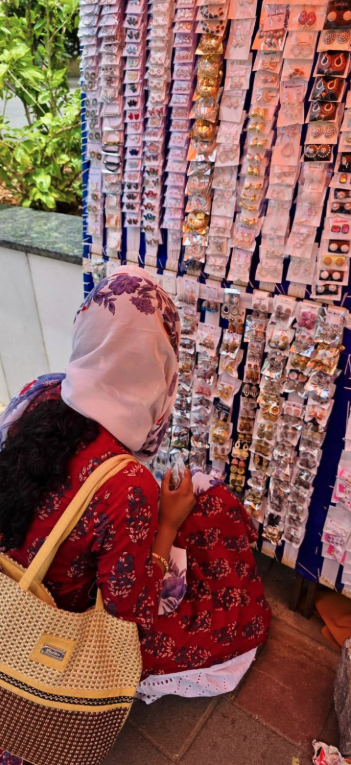
Kanna P. ’26 is studying brain & cognitive sciences with a minor in anthropology. This summer, she worked at a healthcare clinic for underserved communities in Bangalore, India.
In the picture: “Enjoying one of my favorite hobbies since arriving in India: shopping for jhumka earrings at roadside stalls!”
MISTI India Intern Stories
How I Want to Measure Success
What are your metrics of quality and happiness in life? Kanna reveals what fulfillment means to her, and it’s not about possessions.
Experience Punjab in a way that I haven’t before
When I arrived in Cheema, Punjab, for a second, I felt like I was in a dream. I had never been to a town like Cheema. Actually, I don’t think…
Talking about Caste and Affirmative Action in India
By: Mai Nguyen Class of 2022 | Mechanical Engineering Internship – India
 MISTI Blogs