Seoul, South Korea.
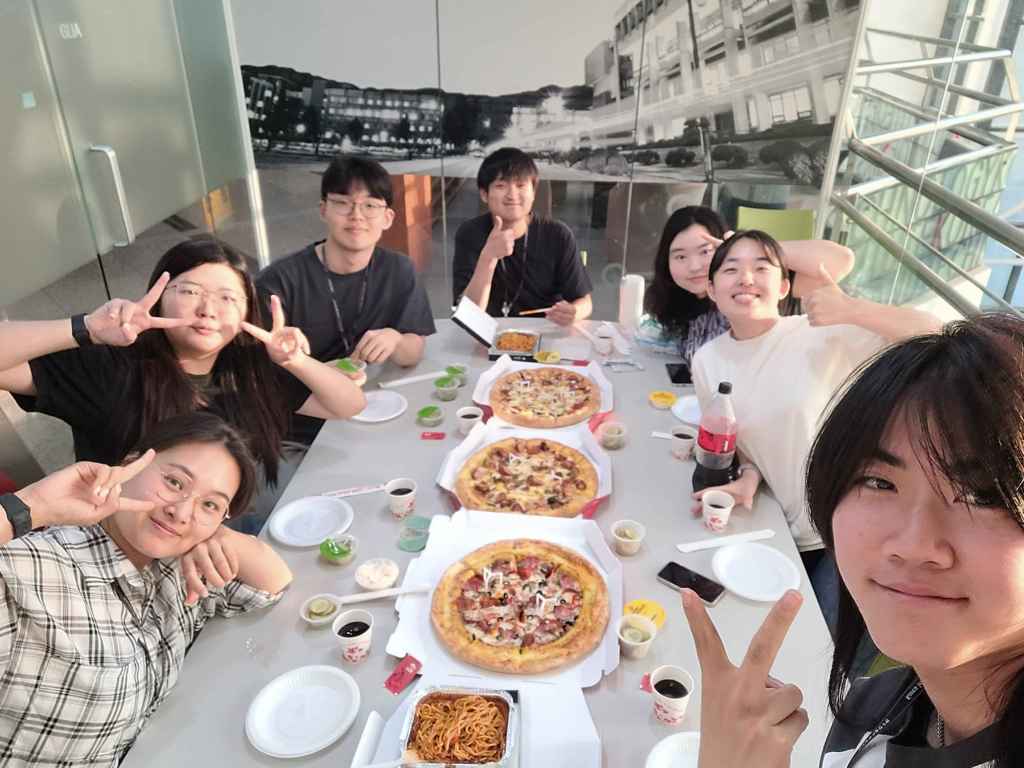
It was the first meeting with my principal investigator, the head of the lab I would be working in for the summer. His office room looks lived in, trinkets and photobooth pictures of my soon-to-be labmates posted on the wall. I would shortly learn it was a tradition they had after each night of drinking and eating, pinning an extra printout onto the available surfaces. I had come in pretty early, the building quiet before the morning lull of the usual researchers strolling in.

He shook my hand softly and bid me to sit down. I had moved into the dorms just yesterday, lugging behind my bandaged suitcase (the heaviness had collapsed a wheel) up and over the deceptively mountainous city of Seoul, baking between the sun and the muggy heat radiating off the asphalt — juggling my backpack, jackets, and six hours of sleep across 2 days.
First impressions, first impressions are important.
Perhaps because that sentiment kept ringing through my head, drilled into me during the MISTI Korea culture trainings, I aimed to sit in the set of three chairs, but in my overly conscious desire to give him space as he moved, swerved to almost sit down in the lone opposing chair obviously meant for him. In that brief second he gestured to the three chairs. This interaction all happened in a rushed flutter. My mind was on high alert, as I knew how important hierarchy and politeness was held in Neo-Confuscious Asia. (Though I do recognize these days, that pull becomes less with each new generation.)
I just arrived and I already messed up. Does he think I’m rude? Careless? Maybe a bit thoughtless —
Settling down into my seat, I briefly worried about the mistake, but we quickly delved into introductions, giving me no time to potentially berate myself further. It was a friendly conversation, his English nearly perfect. Are you a sophomore, junior? What did your last lab work on? Why Korea? Why not stay at MIT?
He laughed heartily at the mention of my childhood obsession, the South Korean online game MapleStory. I fell into a natural beat — smiling, gesturing energetically, and showing my usual characteristic enthusiasm.
There’s a brief lull of silence as the topic peters off.
He’s sitting kindly in front of me. A delicately tranquil yet tense space floats between us — I feel as if you would know these moments, too, a mutual wonderance of what the next words will be. I don’t know if I’m looking at him for guidance on the conversation, having been led with questions thus far, or if I myself am searching for something to ask. Hesitant, but maintaining our sustained eye contact, he decidedly breaks the silence first — it comes out what seems very suddenly.
“What is your sexual identity?”
I paused for a second, but hadn’t been very shocked either. There were a few layers to that; the fact I had a deep voice but press-on nails (courtesy of my recent graduation), the classic “Koreans are not afraid to ask people about their personal information”, etc — though to his benefit, he didn’t show entitlement when asking about it. He even throws in an apology for the question, though it doesn’t change the fact there is an answer to be expected.
Bi? Pan? All is good? — is what quickly flashed through my head.
“I’m male,” I said with an amused smile.
I’d assumed he hadn’t been asking from the onset whether I was into men or women, and that the question had been a result of language-cultural difference. In the US, there is a more (or less) defined difference between gender and sexuality that’s in the public sphere’s discussion. It was a very East Asian thing to compound sexual identity and gender expression as a single concept. Heck, people in the United States still certainly do.
Another layer to this, however, was that my supervisor most likely learnt English through academic settings, and so could’ve potentially meant sex as the scientific terminology for gendering rather than in reference to sexual attraction. Including the word “identity” perhaps showed his openness to different forms of sexual(gender)-identity, and so perhaps he wasn’t actually confounding these concepts cognitively, even if he was linguistically.
I feel as if I could make a 2×2 chart, each box being their own domain.
| Expression | Identity | |
| Gender | Gender-Expression | Gender-Identity |
| Sexual | Sexual-Expression | Sexual-Identity |
I’d say expression is how you show or conduct yourself to the world, while identity is who you regard yourself as towards your own self. They may be correlated but may not be mutual. For example, you may think of yourself as a kind person (identity), but perhaps you remember the times you pass the homeless on the street, doing your best to ignore their existence (expression). But perhaps because you are kind, maybe these moments eat at you.
In my opinion, the pool of identities hardly changes across wide demographics, but expression may heavily fluctuate between cultures and time. And while gender is who you are, sexuality is who you like. All in brief terms.
Tangent aside, he laughed and apologized again for asking. “I had thought so too, but just to make sure. With the long hair it was a little confusing,” he made a general motion towards me, confirming my suspicion that his intended question was in fact regarding gender.
I made no mention that my hair had been even longer one year ago.
Perhaps to save some face, he tagged on a line about how asking me that was good for clearing confusion amongst my labmates when first meeting me. (Though, I equally had doubts my labmates would ask him about my gender, or that he would suddenly announce at our first group meeting, “This is Hanjie, he is male.”)
To be clear, there was no undertone that “Men shouldn’t have long hair,” from him. Maybe that I look a little feminine, which, I would honestly agree with. I could tell he had no ill intentions, and so we happily moved on with our conversation.
Back when I’d felt uncomfortable with myself, my perceived being as male or not, I’d made sure to keep my hair very short. During that time frame, when I received this genre of question, it was bittersweet. “I’m female, but you can use any pronouns for me, I don’t mind.” I would have said with rocks in my throat. Happy to have been ambiguous in the first place, but frothing with self-denial to commit.
The Covid pandemic lockdowns were a strange privilege for me. A recent MIT acceptee, I had access to the medical aid to transition while in isolation from my peers. Coming out of the lockdowns, no one needed to hear what my voice sounded like before. (Prepubescent male, to be honest. My speech patterns hadn’t needed changing at all.)
As I finally got to settle into my own skin, these small distinctions no longer held much weight over me. Sure, sometimes I still wonder if people know what the scars on my chest mean, if my friends wonder why I only use the stalls (Does he only ever sh*t? Is he self conscious about his ****?) – But now I simply think I look nice with longer hair.

It’s a topic that follows me throughout my time in Korea, even within the first week. Slurping up cold noodles, a Korean staple during the summer, I overhear the questioning conversations between the store aunties as I get water for my group. “Yes that’s right I am a man,” I provide them. “…He was a man!” When I’m buying a fan near Gyeongbokgung palace to fend off the heat, “You’re a man, right? You’re so pretty for a man!”
This is the usual exclamations from the aunties, happy to express “attractiveness”.
From the male cab drivers it’s, “So you were a man. Because of the long hair I almost thought you were female.” A much more amusingly clinical expression. I can often see the thoughts halted behind their eyes and voice, hesitant to show anything that could be read as a potential inclination of homosexuality. It’s often the men who ask if I have a girlfriend though (a common question in South Korea), and express shock when I say no.
At the Hanbok Rental near the palace, I stood amongst the selection of jeweled and flowered hair pins. If you wear Hanbok, entrance into the palace is free, a popular must-do amongst tourists or for wedding photoshoots. I had asked one of the staff if it was okay for me to wear the pins, though I hadn’t wanted the service for my hair to be braided. She agreed and I made friendly conversation with them, learning that the three were immigrants from China.
From the store owner speaking to herself behind the racks of traditional tops and bottoms, it’s “Why is a man wearing the hair pins..?” Because I would like my hair to be pretty, I guess.
I have these same kinds of conversations during my six-hour long sessions with my tattoo artist, a kind but brutally honest Italian who’s lived in Korea for eight years. The conversation is a helpful distraction from the pain, though I don’t believe my pockets of restrained laughter are helpful for him.
“While I would totally be fine holding hands with my partner in Korea, in Europe I might get punched in the face. Here, people won’t really bother you about it,” he tells me along the steady thrum of his machine piercing my skin.
In the Western world, though the laws are more progressive on LGBTQ+ rights (and there has been some remission), you were paradoxically more likely to face hate crimes. Despite the seeming directness of people, the attitude in East Asia is much less non-confrontational about these things, and so in practice you might feel much safer despite less protection under the law.
For the LGBTQ+ community in East Asia, the majority atmosphere reads as, “We can accept you if we can pretend you do not exist.” While it makes living in society easier, on a personal level it leaves people feeling more estranged with their own being or the potentiality of ever letting their close ones know. It’s a paradoxical air I know well specifically as a transmale. Your subject was more or less erased from the public sphere, but because of that you could live life in relative anonymity. If you said you were male with enough confidence, looked or sounded the part, people would take you as male without second thought. Especially here in South Korea, where things like fashion or makeup for men were much more widely accepted. I’ve been more mistaken as a male-to-female transgender in life (even before transition) than I have been accurately clocked as female-to-male.
We have more conversations, and I feel I’ve learned more over that span of three days than I had in a while.
I can’t help but to think that since LGBTQ+ issues are more visible in the Western world, they’re also more easily weaponized for the agenda of groups or institutions, whether that is pro or against. When really, LGBTQ+ people are just people, like all people, who want to live their lives in peace.
If I were to cut my hair shorter, if I stopped wearing such flashy accessories, if I didn’t occasionally darken my eyes with eye-shadow, no one would have to bat an eye at me for the rest of my life. Once you start stepping outside that “male” box even slightly, you garner more attention. At that point it’s no longer even a trans issue anymore, that’s an issue of what we box off as “This is male. This is female.” But why must I live my life like that? Boxing and categorizing? Who is that for?
It’s what makes “coming out” as FTM (female-to-male) so hard once you “pass”. There’s many conversations regarding activism vs being “stealth” as a FTM. My single fear on this subject is that – despite not a single thing about me changing, once I come out, there are those who won’t see me as just “Jie” anymore. Now to them, I am simply a transgender, someone they need to walk on eggshells around to not be rude, that single phrase occupying their minds in their interactions with me. I’m fine with questions, I’m happy with discussion. At the end of the day what I want is that when people talk with me, they are looking at Me.
. . .
When I had been ruminating in high school whether it was “worth it or not” to be trans or just “accept my fate” long term, I had certainly tried a lot harder to act “male”, to look “male”. Now that I look at myself as I do, rather than guilt and self-consciousness, I find some fun and amusement in the ambiguity. If I were to use terminology, being more secure in my gender identity allowed me to be more free how I expressed my gender, lending me confidence even when that expression may lean more feminine at times, more masculine at others.
It’s not that I “think” I am a boy. I’d be the first person to know that I was assigned female at birth.
It’s me at 13 years old, sitting in the middle of Costco, looking at the most average Asian guy there could be — wondering why I couldn’t be him. It’s me looking at my chest and feeling a disconnect of the thing that’s there, my body just a flesh robot I happen to pilot. It’s me saying “Well, you know, if I could be reborn again I would want to be a boy. But I know I can’t do anything about it.” Until the day came where the doors opened for me — the startling and breathtaking realization dawned, I could do something about it. (Thank you, MIT Medical insurance.)
“He has an interesting style, but he is indeed a boy.” Perhaps I am just me.

Hanjie Liu is a member of the class of 2024 studying Computation and Cognition. This summer, he is researching Neuroscience at KIST in Seoul, South Korea.
 MISTI Blogs