
The markets in Accra, Ghana, are massive! The Makola Market spans several blocks in every direction, and it’s filled with people’s mini-shops under tents (pictured below). Amie (MIT ’27) and I are spending the summer in Ghana working for Moving Health — a D-Lab start-up that designs, fabricates, and operates tricycle ambulances in remote regions. We needed to go to the market for some fabric for a tent, which led us to Makola. As soon as we arrived, we glued ourselves to our coworkers as they led us through the dense streets. I was distracted by the huge variety of things sold here, from toothbrushes and food to engines.
Once we got to the industrial supplies section, I was taken aback by what looked like a farmer’s market for engineering materials. To my western eyes, it looked like a chaotic way to sell supplies, but as we continued shopping I realized there were amazing benefits: we had access to experts helping us choose the right material, and the seamstresses were just next door making it a more seamless (pun intended) process. A market leader ensures the layout remains relatively constant, decides where new shops start as old ones close down, settles debates, and such, as our coworkers explained to us. Because of the static layout, vendors are able to become friends with each other and their regulars — which makes it feel like one big community.

Accra has felt like a very in-person community-centered city which honestly took some adjusting to. In America I don’t really talk to people unless I need to; by contrast, in Accra, our neighbors say good morning, afternoon, and night to us every time we walk down the street. A Bolt driver (a ride-sharing app like Uber) remembered us from a week ago and now we know his life story. A pottery instructor let us stay half an hour after closing and insisted I finish a way-too-ambitious pentagonal clay hut. The following day, he took time out to ensure everything fit nicely together. People are kind, welcoming, and want to get to know you — they lead with personality first and I’ve really enjoyed taking a step back and trying to do the same. In the US, I feel like I’m always thinking of the next task or goal which makes me feel less present talking to people. I’m trying to let the focus on efficiency slip away, and I hope Ghana can teach me how to. Everything’s a work in progress, I guess.

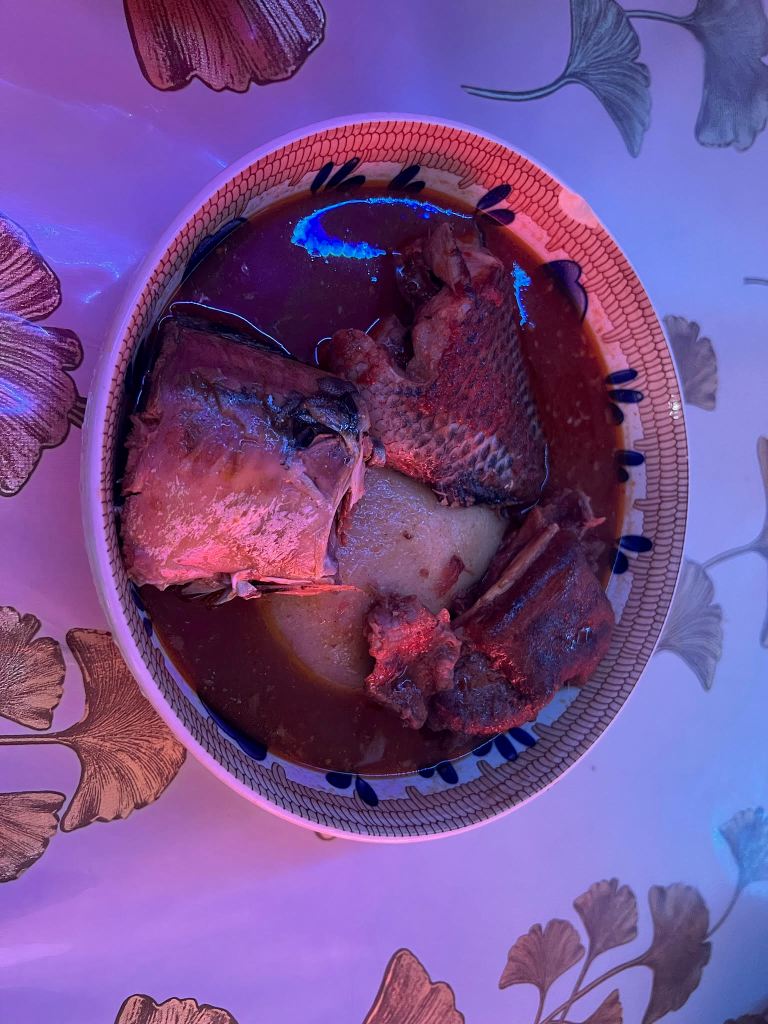
I really love that part of the community-centered living reflected in Ghanaian cooking; many of the dishes here are stew-based or intricate, thus need to be made in large quantities. It feels like it’s supposed to be served in communities or with families. It reminds me a lot of traditional Arab cuisine. For example, Mansaf’s sauce involves several days of preparation and a couple of hours for the meat to stew, so we usually cook it for several families at a time. Although the spices and dishes here are very different from what I’ve eaten in the past, I’m enjoying feeling like part of a whole again 🙂 As a side note, this type of cooking has given me zero percent intuition for portion sizes, so I would also like to extend an apology to French House (and their bank account) for regularly trying to cook ~15 pounds of beef for ~30 people haha.
Some of my favorite moments so far in Ghana have been learning about its history and current events from my coworkers, museums, and other locals. Kwame Nkrumah’s museum was especially enlightening. Nkrumah was one of the largest political figures involved in the fight for independence from the British and became Ghana’s first president in 1957. He was a large proponent of Pan-Africanism and established the Organisation for African Unity (OAU) while trying to create a united and liberated Africa. Within Ghana, he created the Accelerated Development Plan for Education and news agencies, industrialized Ghana’s economy, built a dam to generate electricity, established health care, and so much more. Unfortunately, as most good things come to an end, the CIA was scared of a united Africa and a strong Ghana and staged a coup against Nkrumah in 1966 [1]. Since then most of Nkrumah’s factories and industries have been closed, there is widespread corruption, and much of Ghana’s goods (gold, cocoa, oil) are controlled by foreign companies. It’s an unfortunate reality, but not even close to the whole story of Ghana. Because of the limited industries and goods developed in Ghana, I’ve seen some of the most resourceful and impressive engineering. From steel, foam, and tricycle tractor parts, Moving Health has made an ambulance that can carry pregnant women to hospitals over 50 miles away over pothole-filled dirt roads. Like, how cool is that?
From steel, foam, and tricycle tractor parts, Moving Health has made an ambulance that can carry pregnant women to hospitals over 50 miles away over pothole-filled dirt roads. Like, how cool is that?
Maya Ayoub ’26


Learning about Ghanaian history has been a huge part of my experience here, so I wanted to mention it in this blog, but I’ve been having a hard time trying to connect it to my identity. To the core, I think I just really want to learn about people’s perspectives and their histories. Sometimes I question how much I really want to be an engineer, but I don’t really question how much I love learning more about the world. I think that’s what initially drew me to science and eventually engineering as it provided a framework for understanding the world around us. As I continue to interact with a diverse set of people, I’ve been drawn more and more to modern history. The history textbooks I’ve read at my American high school have been pretty one sided, so learning Ghana’s history from Ghanaians has been such a treat. Sometimes I forget I’m more than just a MechE student, and these past two weeks have been a recentering experience that has rekindled my love for learning about the world in every subject. There’s so much to the world, and I’m excited to be living in it!
Sometimes I forget I’m more than just a MechE student, and these past two weeks have been a recentering experience that has rekindled my love for learning about the world in every subject.
Maya Ayoub ’26


Hi there! I’m Maya Ayoub a member of the class of ‘26 studying Mechanical Engineering. This summer I’ll be an intern with Moving Health in Ghana to electrify ambulances!
 MISTI Blogs