Upon being placed in Tel Aviv, Israel, for my summer research program, I knew I wanted to attend the annual Pride Parade, which is the largest in the Middle East. As a bisexual woman with Jewish heritage, I was excited for my first immersion into Israeli history and culture to also be my first LGBTQ+ event.
For the first time in my life, I saw examples of my future self, of people representing my Jewish heritage and seemingly living confidently in their sexualities.
Tatiana Vassiliev
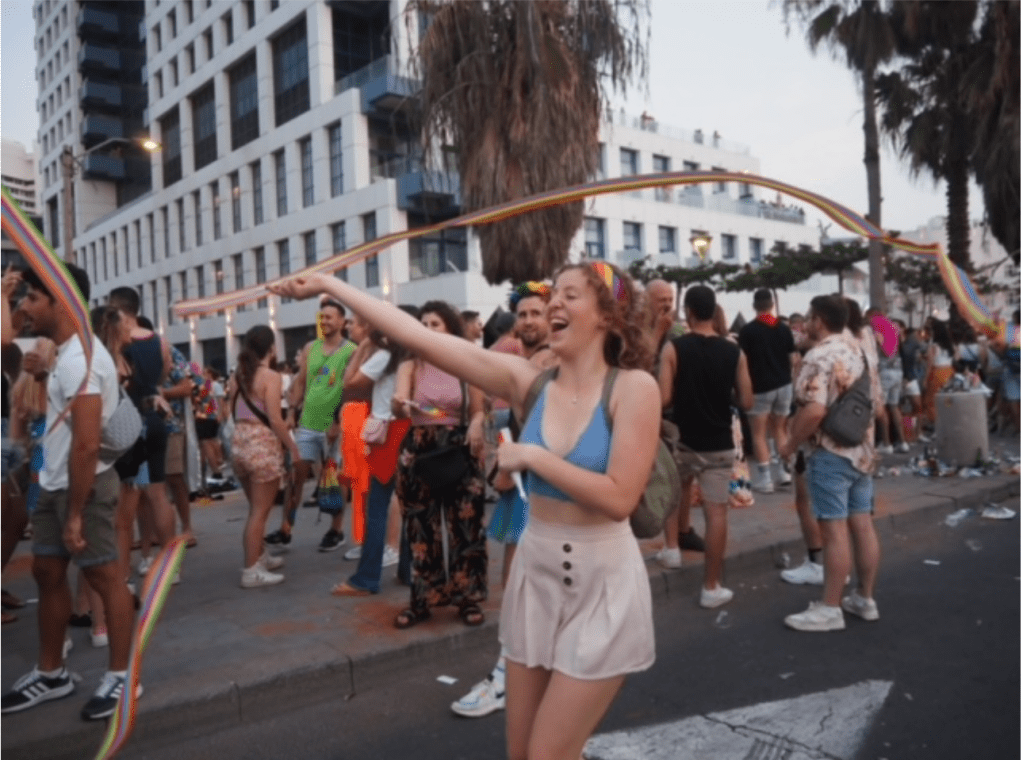
At Tel Aviv’s Pride Parade, I felt seen, heard, and safe. I was surrounded by a myriad of people, all celebrating and supporting the LGBTQ+ community. For the first time in my life, I saw examples of my future self, of people representing my Jewish heritage and seemingly living confidently in their sexualities.

However, my illusion of peace was quickly broken, as I found out that the weekend before, a counter-demonstration had occurred during the Pride Parade in Jerusalem. The difference was stark and unavoidable – stereotypically secular Tel Aviv promoting diversity, and values as they see as sacred.
A week later, I visited Jerusalem for myself and was further disillusioned in my perception of Israel as a homogenous pro-LGBTQ+ country. While in Tel Aviv, the sight of same-sex couples kissing is not an uncommon one, in Jerusalem, I felt a rapid increase in tension at the mere mention of my girlfriend and quickly changed my lock screen from a picture of us to a picture of the scenery. I am privileged to be able to hide my identity with a click of a button, and can imagine that many of those living permanently in the country may not have the ability to do so.
I hope to continue understanding the different aspects of my identity and actively working to find ways to create comfort for myself, even if my surroundings do not encourage it.
It was powerful to see the two extremes of expression of sexuality under the same religious country of Israel. Within the blanket term of Judaism, perspectives on religious practices differ momentously, and so do the people themselves. My coworkers discussed the variability of their own lives and adherence to religious values in different cities, and even different settings within the same city. One coworker attends weekly Shabbat dinners, but never actually keeps Shabbat for the full twenty-four-hour period. Another wears a Kippah all of Friday before and after synagogue but does not wear it the other days of the week. A third keeps kosher with family but will eat at non-kosher restaurants when out with friends. Israel is not uniform in any aspect, and similarly to me, Israelis experience different situations and societal norms almost everywhere they go.
While my coworkers are unable to change their families and the views of others, they actively seek out forms of expression that make them comfortable within their communities. By following their lead and navigating my own sexuality in different areas of the country, I am also able to reflect on how I navigate this same identity in different areas of my life at MIT.
In some groups on campus, I am confident in my sexuality. In others, I refer to my girlfriend as my partner, and find other forms of expression that are comfortable for me. I am learning firsthand that sexuality and expression are fluid, and a uniquely personal experience. I hope to continue understanding the different aspects of my identity and actively working to find ways to create comfort for myself, even if my surroundings do not encourage it.
 MISTI Blogs